
Taiwan FemTech Industry Map: The Missing Piece of Women’s Health Technology

Taiwan FemTech Industry Map cover image

Category: FemTech ・ Keywords: Taiwan FemTech, Women’s Health Technology, Japan FemTech
Japan already has nearly one hundred women’s health technology brands spanning menstruation, infertility treatment, menopause, and sexual health. Government legislation, corporate evaluation systems, and civil communities are all pushing in the same direction. In Taiwan, FemTech momentum has long existed as well. From public advocacy for menstrual cups to period underwear exported to Japan, every “first” has been driven by real needs and women willing to speak up.How many brands are currently building in Taiwan’s FemTech space? How far has Taiwan FemTech come in recent years, and how does it differ from Japan? This article shares the current landscape and gaps in Taiwan’s FemTech ecosystem.

Key Takeaways

  • FemTech covers menstruation management, fertility care, menopause, intimate wellness, and sexual health across a woman’s life.
  • Japan has built a mature FemTech ecosystem supported by policy, corporations, exhibitions, and communities.
  • Taiwan’s FemTech landscape has gradually taken shape through menstrual cups, period underwear, intimate care, and sexual wellness brands.
  • Sexual wellness and female self-care are likely to be among the most important growth areas in Taiwan FemTech.

What Is FemTech? A Category That Supports Women Throughout Life

FemTech stands for Female Technology, a term coined in 2016 by Danish entrepreneur Ida Tin. It was originally created to help investors better recognize this category. The definition is broad: any product, service, or platform that uses technology to address women’s health needs can be considered FemTech.

It includes menstrual management, pregnancy and infertility care, menopause support, intimate wellness, sexual health, and even gynecological cancer screening and genetic testing. In other words, FemTech corresponds to the entire health journey of women from adolescence to old age. It is not a niche market, but a full life-cycle industry.

How Did FemTech Develop in Japan?

The development of women’s health technology in Japan has been driven simultaneously by three layers: public policy, civil organizations, and the private market.

The Japanese Government Put FemTech on the National Agenda

In recent years, the Japanese government has explicitly placed FemTech on its policy agenda. The Cabinet Office included “promotion and further utilization of FemTech” in its Women’s Empowerment Policy 2024. Within the Liberal Democratic Party, a cross-party parliamentary league for FemTech promotion was established to push legislation. The Ministry of Economy, Trade and Industry launched pilot subsidy programs, while the Ministry of Health, Labour and Welfare established a comprehensive women’s health center.

What is especially worth noting is that the Nadeshiko Brand evaluation, jointly organized by the Tokyo Stock Exchange and METI, added “initiatives addressing women-specific health issues” as a scoring criterion. This means supporting women’s health is not only a moral choice for brands, but also a factor that can directly affect corporate capital-market evaluation.

Civil Organizations Have Strengthened Ecosystem Visibility and Cohesion

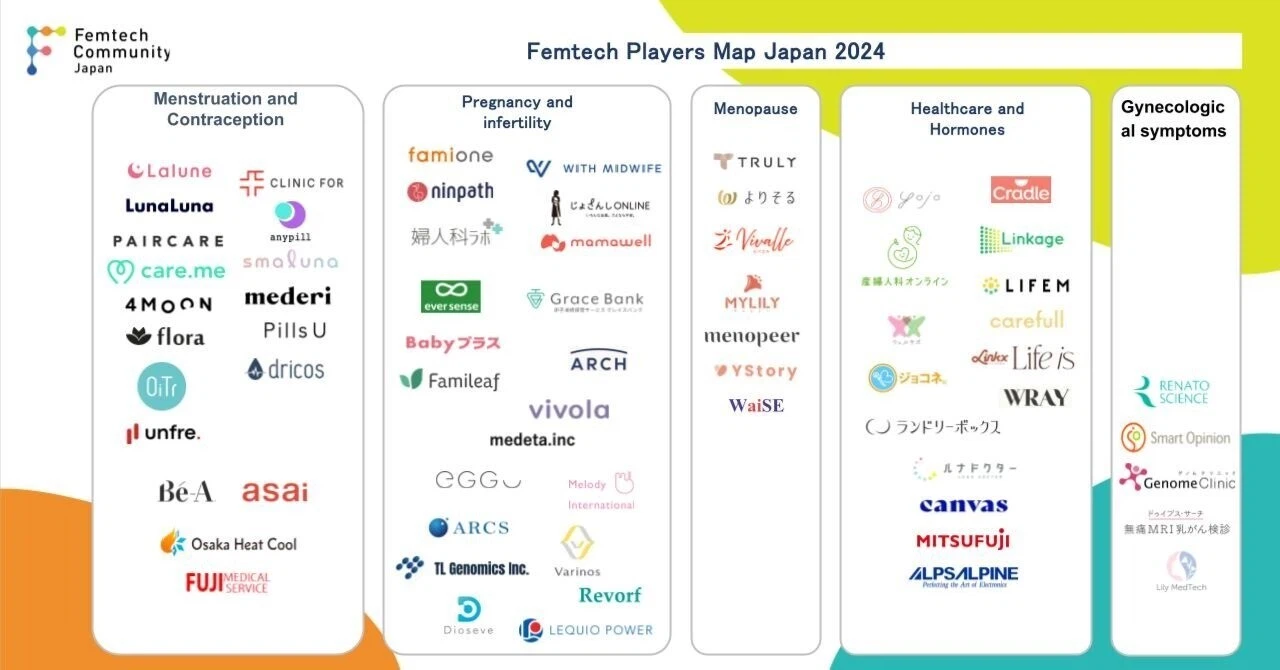
Founded in 2021, Femtech Community Japan has become an important glue for this ecosystem. Through its annual FemTech Players Map, it had listed 66 companies by the end of 2024, spanning five categories: menstruation and contraception, pregnancy and fertility, menopause, healthcare and hormones, and gynecological symptoms. It also regularly hosts forums where founders, investors, and policymakers sit at the same table, while continuing public education to normalize women’s health discussions.

The map itself is a narrative tool. It makes the industry visible, comparable, and investable.

On the exhibition side, events such as Femtech Japan and Femtech Tokyo gather 50 to 200 exhibitors every year. Sexual health, menstrual care, menopause services, and fertility treatment all have dedicated sections side by side. In such physical spaces, it becomes natural for “adult wellness products” and “menstrual cups” to appear in the same venue. Desensitization happens in real space.

Sexual Health Is the Fastest-Growing FemTech Segment

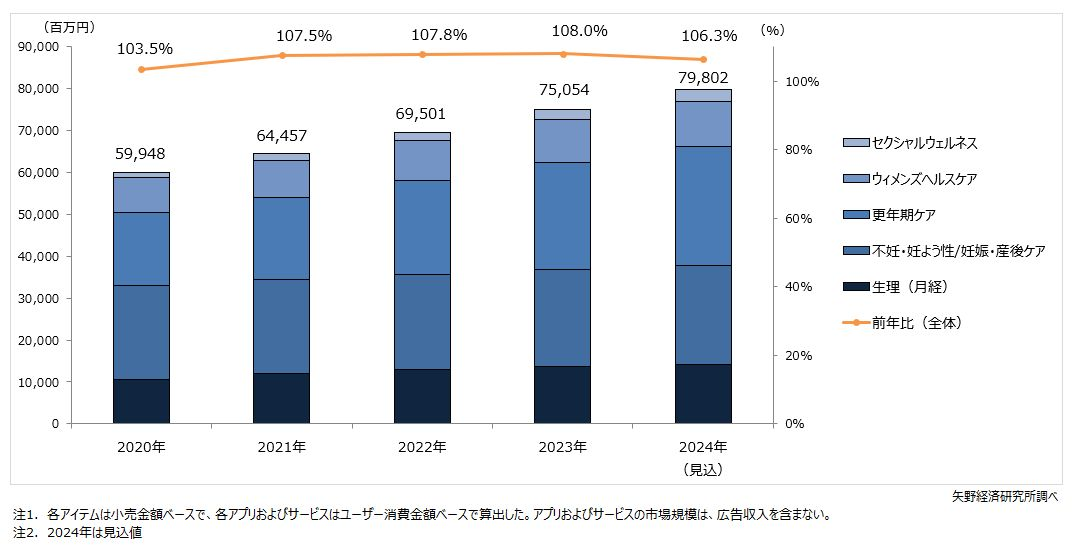
Japan FemTech market growth chart

Source: Yano Research Institute, Japan

Yano Research Institute formally divides the Japanese FemTech market into five major categories: menstruation-related products, fertility and pregnancy care, menopause care, women’s health support including intimate care and gynecological disease support, and sexual health. The market was estimated at 80.3 billion yen in 2024 and is expected to reach 88.8 billion yen in 2025. Growth momentum is shifting from the early menstruation-related segment toward menopause and sexual health.

The FemTech e-commerce platform Fermata places sexual health clearly at the center of its category strategy. Its founder argues that making such products publicly visible is itself an act of breaking taboo.

The Starting Point of Taiwan FemTech: Crowdfunding and Public Action

Taiwan’s FemTech industry did not start from zero. It has been built through several very concrete “firsts.”

In 2015, Menstrual Cups Opened the First Door

Vanessa, founder of Kanya, launched a public petition movement that broke through regulatory barriers preventing menstrual cups from entering Taiwan legally. The significance of this was not just the launch of a new menstrual product. It marked the first time menstrual issues entered public view through collective action. Taiwanese women began openly discussing their bodies online. Kanya later continued to launch tampons and menstrual discs, repeatedly setting local crowdfunding records for menstrual products.

GomuMu Redefined Menstruation Through Brand Language

Rather than taking a regulatory advocacy route, GomuMu turned period underwear into a design brand. Its heavy-metal-style advertising transformed the frustration of menstruation into a personality statement, breaking away from the long-standing “light, white, invisible” narrative of conventional sanitary pad advertising. With more than 300,000 pieces sold and exports to Japan and Hong Kong, GomuMu proved that menstrual issues can be shaped into a real market language.

Intimate Care Moved from Drugstore Shelves to Premium Positioning

VIGILL has cultivated the Taiwanese drugstore channel for more than 40 years and served as the entry point for many Taiwanese women to first encounter the idea of intimate cleansers. Relove moved in another direction, adopting a premium positioning, entering department-store counters, and exporting to overseas markets. It has tried to elevate intimate care from a functional need to a daily wellness ritual. Together, these two brands represent how the same category can look very different across generations.

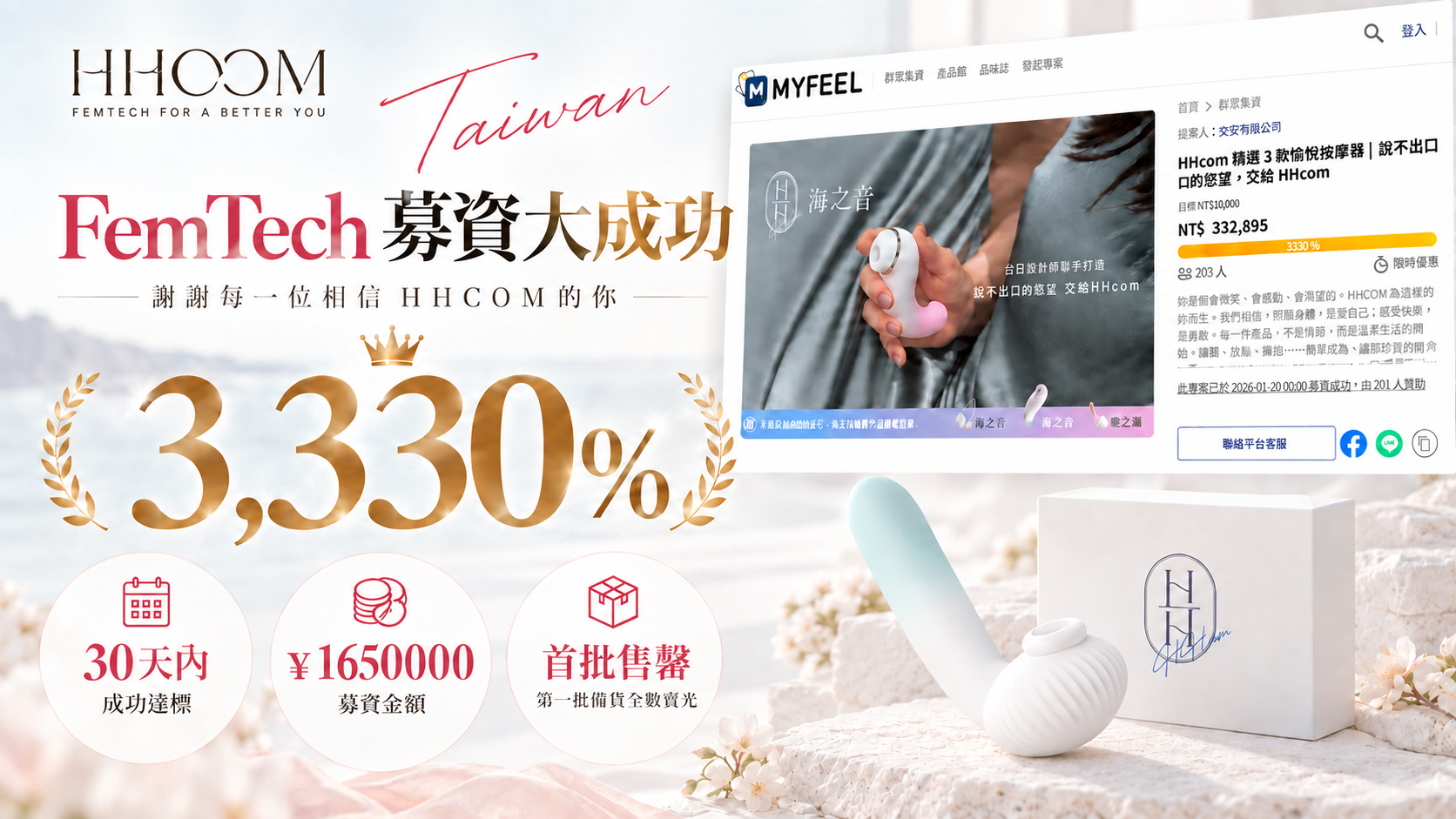
HHCOM elevates sexual wellness into a premium, luxury experience.

HHCOM募資

HHCOM’s debut of its women’s health product line on Japan’s crowdfunding platform MYFEEL immediately demonstrated strong market appeal and brand potential. Within just one month, the campaign successfully raised 330,000, significantly surpassing its initial target and underscoring the growing awareness and resonance of women’s health issues among local consumers. This outstanding achievement reflects HHCOM’s precision in product development, brand positioning, and market communication, while also laying a solid foundation for future expansion across Japan and into the global market. Through the influential MYFEEL platform, HHCOM effectively conveyed its product philosophy to a broader target audience, further strengthening brand credibility and reputation, and marking the beginning of a new chapter in the women’s health sector.

Fertility Tech Has Become More Digital Through Policy Support

As local governments gradually introduced egg-freezing subsidy programs, institutions such as Stork Fertility Center and TFC Taipei Fertility Center began moving toward digital services. Appointment apps and AI-assisted treatment management have made IVF and egg-freezing journeys more transparent for patients.

Comparing the FemTech Maps of Japan and Taiwan

Japan FemTech industry map

Japan FemTech industry map source: Femtech Community Japan

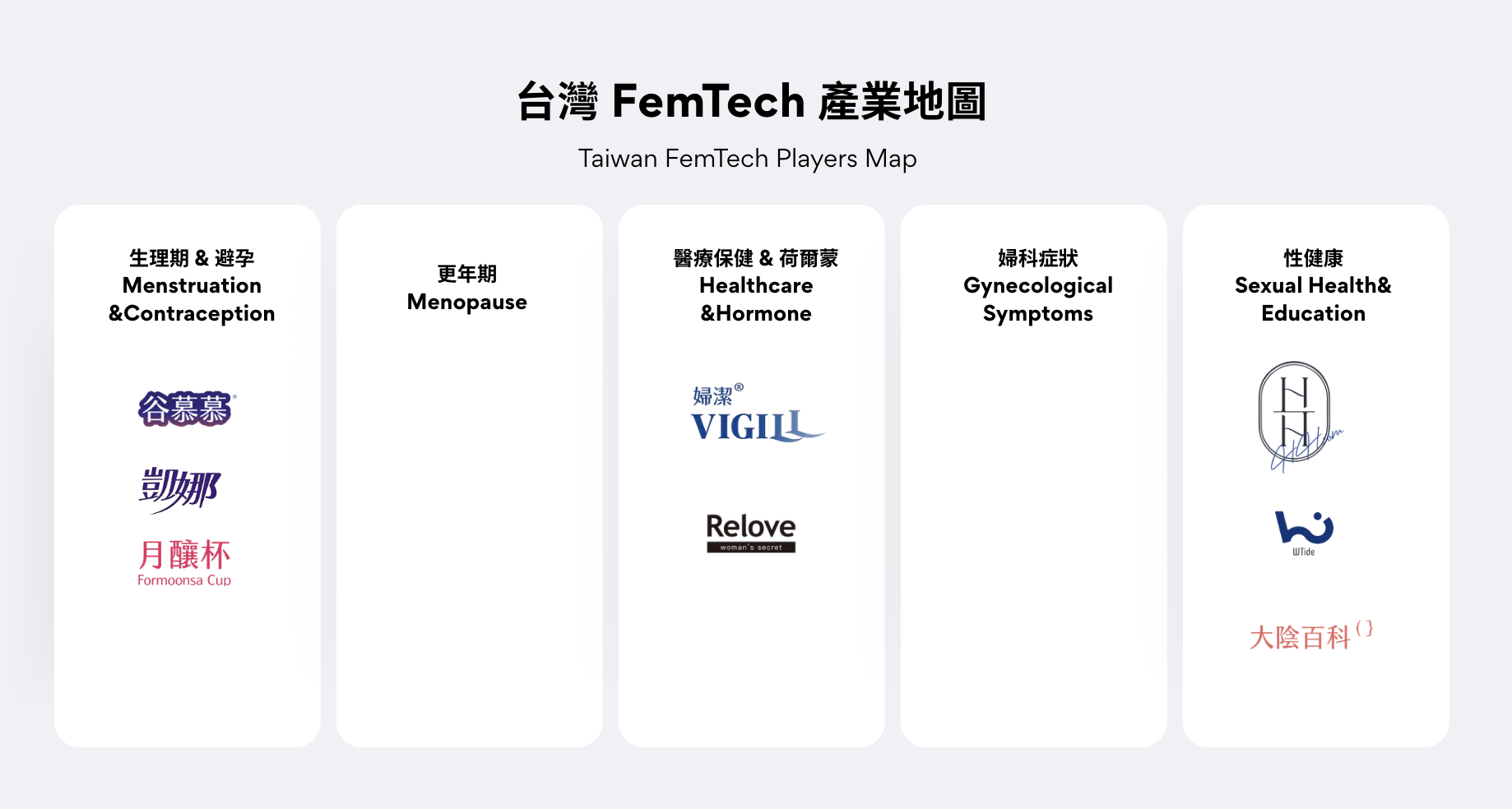
Taiwan FemTech industry map: (Illustration by HHCOM) View here

Taiwan FemTech industry map

In Japan, the shift in sexual wellness products has been significantly strengthened through branding that frames them within the language of female self-care. For example, the Japanese brand wyle positions itself around “design centered on women’s needs,” placing vibrators within a self-care context. Iroha, a women-focused sub-brand under TENGA, entered the mainstream market through award-winning design and food-grade silicone materials, making these products suitable for concept stores and design-media coverage.

In the adjacent field of intimate healthcare, Japan’s hanamisui has been cultivating the market for more than 20 years. Its injectable intimate cleansing gel uses a gynecological care concept to elevate intimate wellness from basic cleansing to proactive care, with product lines extending to postpartum and menopausal needs. Brands like this already belong to a mature market in Japan, while in Taiwan they are still relatively new consumer concepts.

Taiwan also has local brands moving in a similar direction, though from different entry points. HHCOM and WTide are trying to build a local Taiwanese language for sexual wellness: redefining what it means to create products that are genuinely made for women through product design, material choice, and user experience.

Looking Forward to More FemTech Participants in Taiwan

Although there are already players working in sexual wellness, both the discourse and the market education are still in an early stage. That also means there is room for new growth. Taiwan is already on this path, and we welcome more brands to share their participation in the FemTech movement and join this Taiwan FemTech industry map.

Read More

Explore more articles on women’s health, intimate care, and FemTech trends at HHCOM.

Read More

Explore HHCOM

Discover Japanese-inspired women’s wellness selections designed with materials, comfort, and sensory experience in mind.

Browse Products

Learn More About Our Brand

If you believe women’s health and self-care deserve more thoughtful attention, get to know the world of HHCOM.

Learn More

Similar Posts

  • |

    Premium Wand Vibrator Recommendations

    2026 Premium Wand Vibrator Recommendations | 5 Beautiful Picks That Hardly Look Like Pleasure Products

    Written by HHCOM Founder Joe

    |

    Brand Positioning: FemTech Women’s Pleasure & Wellness Boutique

    30-Second Summary

    Who this is for: Women looking for premium wand vibrators with thoughtful design, refined materials, and gift-worthy presentation.

    Main idea: It is not enough for a product to “just work.” The better choice is something truly designed for women, visually beautiful, made with safe materials, and enjoyable enough that you would want to buy again.

    What’s inside: A curated list of 5 premium wand vibrators that look nothing like typical pleasure products, plus an everyday cleaning and care Q&A.

    We already compare ingredients, textures, and packaging when it comes to skincare, so why are intimate toys still often judged by the idea that “as long as the function works, it’s enough”?

    Hello, I’m Joe, founder of HHCOM. HHCOM is a Taiwanese FemTech women’s pleasure and wellness boutique brand. We take women’s exploration of their own bodies seriously, and we care just as much about product function, materials, and design. Instead of impulsively buying several cheap items that get used twice and then forgotten in the corner of a drawer, it makes far more sense to invest in one quality piece that you would actually want to repurchase.

    In recent years, the core logic behind the rise of FemTech brands in Europe, the U.S., and Japan has been simple: women deserve a toy that is genuinely designed for them. This idea has been taken seriously by the Japanese FemTech wand brand BONHEUR. Its founder, Saki Baba, built the brand around the concept of “breaking sexual taboos through the power of design.” What truly makes women willing to approach and own these products is not only their function, but whether the design feels approachable to look at and comfortable to hold without embarrassment.

    Joe’s View from HHCOM

    A truly premium wand vibrator is not just a tool for use. It is a piece women are willing to keep in their lives, place on their vanity, and even recommend to friends. When design, material, and experience all come together, using it becomes something that feels much more natural.

    Below is a curated list from HHCOM founder Joe of five wand vibrators that are so beautiful they hardly look like pleasure products at all—recommended for women who deserve high-quality, high-aesthetic enjoyment.

    2026 Premium Wand Vibrator Selection List

    No.1|HHCOM Cloud Coral (The Cloud Wand)

    If you can only choose one, choose this one. HHCOM Cloud Coral is the brand’s most iconic model, and it is also the starting point of how the term “cloud wand” began circulating across Taiwanese communities.

    The overall silhouette is soft and full, with understated misty color tones. The weight and tactile feel in the hand feel more like a designer object than a typical adult product. Its signature “cloud grip” is truly unusual—when pressed, the softness and rebound of the silicone feel like holding a real cloud in your hand. It is especially well suited for women looking for their first FemTech-designed wand vibrator.

    Product Details

    No.2|HHCOM Sea Melody

    If “quietness” is your number one requirement when choosing a wand vibrator, Sea Melody was designed for exactly that need. Although its name includes the word “sound,” the key design philosophy of this product is actually minimizing sound as much as possible. Its operating noise is extremely light—barely noticeable even when held close to the ear—and it remains the quietest model in the HHCOM lineup, making it especially suitable for users who live with family or roommates.

    Its shape follows a streamlined design language, with no awkwardness in the hand. The lines are so clean that it can be displayed openly on a bathroom shelf without anyone guessing what it is. The color palette leans toward clear cool tones that match bathrooms and vanity spaces beautifully, making its visual quality feel calm and effortlessly refined.

    In terms of function, the vibration levels are more than sufficient, ranging from a soft warm-up to more focused stimulation. It is especially suitable for users who prefer a calmer, slower-building experience.

    Product Details

    No.3|HHCOM Cloud Snow

    For first-time buyers, the two most common barriers are: “it looks a little intimidating” and “I’m not sure if I can accept it.” Cloud Snow solves both.

    Its shape is small, soft, and friendly, and the size in hand feels even more approachable than expected. For users without prior experience, it is not the kind of product that creates immediate visual resistance. The vibration strength ranges from light to medium, and the overall sensation stays gentle, so it does not create the kind of overstimulation that can feel uncomfortable to beginners. The functions are uncomplicated, and the controls are intuitive—just press one button and begin, without needing to study a manual.

    The packaging also follows a refined aesthetic. It feels like a treat for yourself and remains completely tasteful as a gift for a close friend.

    Product Details

    No.4|LELO Lily 3

    LELO is a Swedish brand and one of the global benchmarks for luxury pleasure product design. From packaging to product body, every detail feels worthy of the word “luxury.” Lily 3 looks like a carefully polished pebble, with smooth curves and a solid feel in hand. The moment you open the box, it becomes clear why it is often described as the “Hermès of pleasure products.”

    For Taiwanese consumers, LELO functions more as an international quality reference point. Its place on this list offers a clearer impression of the kind of craftsmanship that premium wand vibrators can represent.

    No.5|iroha mai Suibugaku|Sonic Wand Vibrator

    iroha mai Suibugaku uses sonic massage technology, which creates a sensation completely different from traditional vibration. The body feel is finer, more diffused, and more like soft ripples expanding outward from a sensitive point.

    Its HapticWave® sonic technology received the 2024 German Red Dot Design Award, and it is also the first model in the iroha series to replace conventional motor vibration with sonic waves. The sensation is more delicate, the diffusion effect feels stronger, and the operating noise is extremely low. Inspired by traditional Japanese aesthetics, its elegant coloring makes it look like a decorative object sitting on a bathroom shelf.

    Product Details

    Not Just for Yourself, but Also One of the Most Tasteful Gift Choices

    One of the most overlooked use scenarios for premium wand vibrators is actually gifting.

    In the past, packaging was often too explicit for pleasure products to appear naturally on a gift list. But once brands began designing both packaging and product bodies with the logic of luxury goods, gifting these items became much more natural. When someone receives an HHCOM cloud wand, one of the most common first reactions is simply: “This feels so refined.”

    Whether it is a close friend’s birthday, a singlehood celebration, a reward for yourself, or any moment when you want to give something “useful and tasteful,” every item on this list is a gift you can present confidently and that the recipient is likely to genuinely enjoy.

    Everyday Care & Cleaning Q&A for Wand Vibrators

    Q1|Do I really need to clean it immediately after each use?

    Yes, that is strongly recommended. Silicone does not tend to breed bacteria easily, but if body fluids remain on the surface for too long, hygiene concerns still increase. Cleaning it before residue dries is much easier than waiting until the next day.

    Q2|Can I use normal body wash or hand soap to clean it?

    That is not ideal. Strong alkaline cleansers can gradually damage or discolor silicone surfaces over time. The safest choice is a mild neutral cleanser or a toy-specific cleansing foam, which is easier to lather, better for cleaning corners, and much gentler on silicone.

    Q3|If the waterproof rating is high enough, can I soak it directly in water?

    Models rated IPX7 or above are generally suitable for that, but one detail matters: always make sure the charging port cover is fully sealed and the charging cable is completely removed before soaking. If water enters the charging area, charging issues can still happen even if the body itself is waterproof.

    Q4|How should I store it after cleaning so it doesn’t collect dust or fibers?

    It is best to use the original storage pouch or wrap it in a clean cotton bag, then keep it in a dry, well-ventilated place. One thing many people do not realize is that toys made of different materials should not be stored pressed directly against one another for long periods. Some materials may react over time, causing deterioration or surface damage, so separate storage is the safer method.

    Q5|If I haven’t used it for a long time, do I need to do anything before using it again?

    Yes. Before reusing a product that has been stored for a while, it is best to wash it once with a neutral cleanser or disinfect it with hypochlorous acid spray, let it sit for about a minute, and then make sure the surface is dry before use.

    Q6|Can silicone toys be used with any lubricant?

    This is one of the most common mistakes. Silicone toys should not be used with silicone-based lubricants. When the two come into contact, the silicone surface can begin to break down and become sticky, and that kind of damage cannot be reversed. A water-based lubricant is the correct choice. For example, HHCOM Herbal Tea Tree Lubricant offers a fresh tea tree scent and a hyaluronic acid moisturizing formula that helps improve lubrication longevity and reduce dryness, making it one of the safest and most comfortable options.

    Care Tip:

    Buying a premium toy well is only half of it—you also need to care for it well. Cleaning, storage, and lubricant compatibility can make a huge difference in both product lifespan and the quality of the experience.

    Find the Toy That Feels Like Treating Yourself a Little Better

    Now that the idea of FemTech has become more mature, wand vibrators are already part of women’s self-care. Choosing a wand vibrator that is genuinely designed for you is not fundamentally different from carefully choosing a serum or selecting a massage device that works beautifully for your body.

    You deserve a wand vibrator that is truly designed for you—beautifully designed, made with safe materials, quiet, easy to use, and easy to clean. Something you can buy without embarrassment, and still want to buy again after using it.

    The HHCOM cloud wand series (Cloud Coral, Sea Melody, and Cloud Snow) is currently available through the WTide website and 情趣夢天堂 retail locations.

    Choose a premium wand vibrator that is truly designed for you

    From materials and quiet performance to visual design and real user experience, let your choice become more than “good enough”—let it become part of your personal lifestyle taste.

    Explore the Collection

    Browse HHCOM’s cloud wand lineup and other premium series directly.

    Browse Now

    More Women’s Wellness Articles

    Read more about FemTech, product curation, and care knowledge.

    Read Articles

    Shop Matching Lubricant

    Choosing the right water-based lubricant makes the overall experience more comfortable and reassuring.

    Learn More

  • |

    Beginner’s Guide to Kegel Exercises

    Reviewed by the HHcom Editorial Team

    |

    Last updated: 2026-03-09

    Quick Take in 30 Seconds: Kegel Exercises Made Simple

    Best for: Women who sit for long hours, those rebuilding healthy habits after childbirth, and anyone who wants to improve pelvic floor awareness and intimate self-care.

    Key benefits: Helps you better connect with your pelvic floor muscles, supports daily comfort and control, and encourages a gentle, sustainable self-care routine.

    How to choose your starting point: For beginners, the goal is not doing more repetitions, but learning how to engage the right muscles correctly. If that feels hard to identify, pairing your practice with the Mist Veil | Kegel Smart Ball can make it easier to get started.

    You may have heard the term Kegel exercise, but still feel unsure about how to begin. In reality, Kegel exercises are not just for postpartum recovery—they are a valuable self-care habit for many modern women. Whether you spend long hours sitting, feel out of touch with your body, are recovering after childbirth, or simply want to improve pelvic floor awareness and a sense of inner support, pelvic floor training can be an excellent place to start. In this article, we will walk you through what Kegel exercises are, what benefits they may offer, how to do them, and how beginners can more easily find the right muscles and movement patterns. If you have ever thought, “I’m trying, but I’m not sure I’m doing it correctly,” this guide is for you. If you are also exploring gentle intimate wellness tools that fit your body and lifestyle, you can browse the HHcom full product collection to discover items by material, function, and daily use.

    What Are Kegel Exercises, and Why Do Modern Women Need Them?

    Kegel exercises are a type of training that involves gently contracting and relaxing the pelvic floor muscles. These muscles sit at the base of the pelvis and act like a supportive hammock for the bladder, uterus, and surrounding tissues. They are also closely connected to everyday comfort, core support, and intimate body awareness.

    Long hours of sitting, aging, childbirth, limited movement, and lifestyle habits can all contribute to reduced pelvic floor strength or awareness. This may show up as a feeling of looseness, slight urine leakage when coughing or sneezing, less core stability, or difficulty sensing contraction and release in the intimate area. The goal of Kegel exercises is not to strain hard, but to rebuild awareness and coordination through gentle, consistent practice.

    For beginners, the most important part is not doing more repetitions—it is learning where these muscles are and whether you can truly feel them engaging and relaxing. The more clearly you can sense the pelvic floor, the more effective and comfortable your long-term practice may become.

    From the HHcom Editorial Team

    Many women care about intimate wellness, but are not always sure where to begin. Kegel exercises are a gentle and approachable starting point because they do not require much space or complicated equipment, yet they can help you gradually reconnect with your body. At HHcom, we believe the focus should not be speed or pressure, but helping women feel comfortable, supported, and confident as they learn more about their bodies.

    Why Try Kegel Exercises? 5 Benefits Worth Knowing

    Many people search for Kegel exercises because they want to know what the real benefits are. When done correctly and consistently, Kegel exercises can be a helpful part of women’s daily wellness and pelvic floor care. Here are five commonly recognized benefits.

    1. Better awareness of the pelvic floor: The most fundamental purpose of Kegel exercises is learning how to activate the pelvic floor muscles. Being able to feel the difference between contraction and release is an important first step.

    2. Support for mild everyday bladder control concerns: If you notice slight leakage when laughing, coughing, sneezing, or jumping, the pelvic floor may need more support. Regular practice can help improve your sense of control.

    3. Better core support and body stability: The pelvic floor does not work alone. It is connected to your body’s deep support system. Learning to use these muscles can contribute to a more stable and grounded body awareness.

    4. Greater intimate awareness and body confidence: Kegel exercises are not just about muscle training—they are also about reconnecting gently with your body. Improving awareness of contraction and release can help you feel more in tune with yourself.

    5. Easy to build into daily self-care: Whether you work at a desk, stand for long hours, have recently given birth, or simply want a softer wellness habit, Kegel exercises are easy to begin in just a few minutes a day.

    A gentle reminder:

    Kegel exercises are meant to be gentle. You do not need to hold your breath, strain, or push yourself to do many repetitions at once. Finding the right muscles and practicing consistently matters more than intensity.

    How to Do Kegel Exercises: A Beginner-Friendly 3-Step Guide

    Even if you know what Kegel exercises are, you may still feel unsure about how to do them correctly. For beginners, the first goal is not quantity—it is locating the right muscles. Once that foundation is in place, practice becomes much more meaningful.

    Step 1: Find the pelvic floor muscles. Imagine the feeling of stopping the flow of urine, or gently lifting inward from the vaginal area. The sensation should feel subtle and internal—not like squeezing your thighs or clenching your buttocks. It is completely normal if this feels unclear at first.

    Step 2: Practice contracting and relaxing. Once you think you have located the area, start by gently tightening for 3 seconds, then relaxing for 3 seconds. Repeat 5 to 10 times. It is more important to relax fully after each contraction than to keep going for a long time.

    Step 3: Make it part of your routine. Try practicing after a shower, while drying your hair, before bed, during a quiet moment at home, or while resting. Like skincare, Kegel exercises work best when they become a natural part of your daily rhythm.

    Category Beginner Practice Progressive Practice With Supportive Tools
    Main focus Finding the correct muscles Building more control and stability Making body awareness more intuitive
    Suggested rhythm 3 seconds contract / 3 seconds relax Gradually increase based on comfort Practice along with guided feedback
    Best for Those just starting out Those with stable body awareness Those who struggle to find the right muscles

    From the HHcom Editorial Team

    Many beginners focus first on how many times to do Kegel exercises. But what matters most is sensing the movement correctly. Before increasing intensity, it helps to check whether you are engaging the pelvic floor or accidentally tightening your thighs, buttocks, or lower abdomen instead.

    Common Kegel Exercise Mistakes: 5 Things Beginners Often Get Wrong

    If you have been trying for a while but do not feel much difference, it does not necessarily mean Kegel exercises do not work. Often, the issue is simply technique. Here are five common mistakes beginners make.

    1. Overusing the buttocks or thighs: If you feel the effort mostly in your glutes or legs, the contraction may not be targeting the pelvic floor correctly.

    2. Holding your breath: Kegel exercises should be done with natural breathing, not with the whole body tensed up.

    3. Only tightening without relaxing: Pelvic floor training is not just about contraction. Learning to release is equally important.

    4. Doing too much too soon: More is not always better. Start gently, build awareness first, and then increase gradually if needed.

    5. Continuing without knowing if it feels right: If you truly cannot identify the right muscles, a supportive training tool may make practice easier and more effective.

    A helpful note before you begin:

    If you feel strong discomfort, pain, or are in a sensitive recovery period, it is best to prioritize comfort and go slowly. If you use any intimate training tool, pay attention to body-safe materials, proper cleaning, lubricant compatibility, and gradual use.

    Not Sure How to Engage the Right Muscles? Supportive Pelvic Floor Tools Can Help

    For many beginners, the challenge is not lack of motivation—it is simply not knowing whether they are doing it correctly. Pelvic floor training often feels abstract at first. You may wonder if you are tightening the right area, or if the sensation is too vague to trust. In these situations, a supportive training tool can help make the process feel more intuitive.

    For example, HHcom’s Mist Veil | Kegel Smart Ball is designed to support beginners as they practice Kegel exercises. With its soft cloud-like feel, ergonomic curve, and gentle body-friendly material, it can help users better sense the position of the pelvic floor muscles. Guided rhythm support also makes it easier to recognize the pattern of contraction and release, which can reduce the frustration of not knowing whether you are doing it right.

    If you want to begin Kegel exercises in a more intuitive way, think of supportive tools not as pressure, but as a gentle bridge to stronger body awareness. The key is to choose a pace and an approach that feel natural for you.

    HHcom Recommended Pick

    Mist Veil | Kegel Smart Ball

    A supportive pelvic floor training tool designed for beginners. With a soft-touch material, smooth ergonomic shape, and guided rhythm support, it helps make contraction and release easier to understand and makes Kegel exercises feel more intuitive.

    Please refer to the official website for pricing

    Who Can Benefit From Adding Kegel Exercises to Daily Life?

    Anyone who wants to build better pelvic floor awareness and make intimate wellness part of daily self-care may benefit from Kegel exercises. They can be especially helpful for the following groups.

    Women who sit for long hours: Extended sitting can reduce awareness and support around the pelvis. Kegel exercises can be a gentle way to reconnect with those muscles.

    Women rebuilding their routine after childbirth: Postpartum recovery is one of the times when pelvic floor care becomes especially important, and gentle, regular practice can support that awareness.

    Those experiencing mild leakage or reduced pelvic support: If you notice small daily signs of less support or control, pelvic floor exercises may be a useful self-care habit to explore.

    Those who want to feel more connected to their body: Kegel exercises are not only for concerns—they can also be a meaningful part of a gentle, body-aware wellness routine.

    Frequently Asked Questions

    How many Kegel exercises should I do per day?
    Beginners do not need to do a lot. Starting with 1 to 2 short sessions a day, with around 5 to 10 repetitions each time, is often enough. The priority is finding the right muscles and practicing consistently.
    How long does it take to notice a difference?
    This varies from person to person, depending on body awareness, consistency, and technique. In general, regular practice over time tends to feel more meaningful than doing many repetitions irregularly.
    What happens if I do them incorrectly?
    The most common issue is simply not feeling much benefit, because the effort is going into the buttocks, thighs, or abdomen rather than the pelvic floor. That is why beginners should focus on direction and body awareness first.
    Should beginners use a supportive tool?
    Not necessarily—but if it is difficult to feel the right muscles or you want more guidance, a supportive pelvic floor training tool can help make the process clearer and more comfortable.
    Can I practice Kegel exercises every day?
    Yes. When done gently and progressively, Kegel exercises are well suited to becoming a small part of your daily wellness routine.

    Make Kegel Exercises a Gentle Gift to Yourself

    From pelvic floor awareness and gentle training to intimate self-care, finding your own pace can become a meaningful part of everyday wellness. Even a few quiet minutes for yourself each day can help your body respond with more ease and connection.

    Explore Featured Products

    Browse items related to the themes in this article and find the one that feels right for your first step.

    Learn More

    Browse the Collection

    Discover the HHcom collection by material, purpose, and everyday use.

    Visit Shop

    Read More Articles

    Explore more topics on intimate wellness, relaxation, and women’s health.

    Read More

    Further Reading

  • | | |

    How to Do Kegel Exercises: Strengthen Your Pelvic Floor, Support Vaginal Tightening Training, and Add Pleasure with Smart Kegel Balls

    HHCOM Women’s Wellness Journal•Keywords: Kegel exercises, pelvic floor training, smart kegel balls, vaginal tightening training, bladder leak support

    Curious about how to do Kegel exercises, whether pelvic floor training actually works, and how to choose the right smart kegel ball? This guide walks you through the basics of Kegel exercises, how to do them correctly, how long they usually take to feel effective, and how a more thoughtful FemTech design can bring together training and pleasure.

    Key Takeaways

    • Kegel exercises mainly train the pelvic floor muscles, which are connected to bladder control, core stability, and sexual sensation.
    • For many people, the issue is not a lack of practice time, but not locating the correct muscles, which lowers training quality.
    • Smart kegel balls provide clearer body feedback and help build awareness of pelvic floor engagement.
    • If your pelvic floor is chronically tight, painful, or you are recovering from surgery, self-directed strengthening may not be appropriate.

    What Are Kegel Exercises, and What Do They Train?

    Hi, I’m Joe, founder of HHCOM. HHCOM is a Taiwan-based FemTech pleasure and wellness brand that takes women’s self-discovery seriously.

    Many people think of Kegel exercises as something only postpartum mothers do, or as a routine for bladder leakage that can be done anytime, anywhere, but without knowing whether it is actually working. That impression is only half true. The health of your pelvic floor muscles affects far more than bladder leaks. It also relates to sexual sensitivity, orgasm intensity, and your sense of control over your own body. And the training itself can also feel genuinely pleasurable.

    The pelvic floor is a hammock-like group of muscles that sits at the base of the pelvis and supports the bladder, uterus, and rectum. You may not notice it in daily life, but it is constantly working: when you hold in urine, when you do not leak while sneezing, and when you feel rhythmic contractions during intimacy.

    The goal of pelvic floor training is to help you consciously contract and relax these muscles without compensating with your abs, glutes, or thighs. That is harder than it sounds. Many people tighten their lower abdomen or squeeze their glutes instead, while the pelvic floor barely moves at all.

    How Can You Tell If You Are Doing Kegels Correctly?

    There are two common ways to check whether you are really engaging your pelvic floor muscles.

    The first is to briefly try stopping the flow of urine midstream. The muscle you use to do that is your pelvic floor. However, this method should only be used to identify the area and not as a training habit, since repeatedly interrupting urination may not be healthy for the bladder.

    The second method is to place a finger gently at the vaginal opening. When you contract correctly, you should feel a light squeeze and a subtle upward lift, while your abdomen and glutes stay relaxed. If your whole lower belly tenses up or you do not feel any pressure at your finger, you likely have not found the right muscles yet.

    There is also the opposite situation: an overly tight pelvic floor. If you often feel lower abdominal tightness, interrupted urination, or discomfort during sex, more Kegels may not be the answer. In that case, relaxation and assessment should come first. Kegels are not simply “the more, the better.” Correct direction matters most.

    How Long Do Kegel Exercises Take to Work?

    One of the most common questions is: how long do Kegel exercises take to work? In practice, with correct and consistent training, many people begin to notice improvements after around 4 weeks, with more noticeable changes often appearing around 8 to 10 weeks. If the goal is to improve bladder leakage, training is usually recommended for at least 3 months.

    A daily practice of 10 to 15 minutes is generally suggested. It does not have to be done all at once; you can split it into smaller sessions. Like any other muscle group, the pelvic floor also needs recovery time, so complete relaxation after each round is important.

    But when someone has trained for three months and still feels nothing, the problem is often not time. It is usually the quality of each session. If you cannot sense whether you are contracting correctly, you cannot meaningfully adjust your form. That is why many people start looking into smart kegel ball training for clearer feedback.

    What Are Smart Kegel Balls, and Why Do They Help?

    Smart kegel balls are one of the better-known tools for women’s pelvic floor training. Once inserted, the body naturally reacts to prevent the ball from slipping out, which triggers a reflexive pelvic floor contraction. This is not just a mental command. It is a real physical response.

    For many people, the first time they insert a kegel ball and stand up, they suddenly become much more aware of where the pelvic floor actually is. That “now I finally know what I’m trying to train” feeling is exactly what can be hardest to build with hands-free Kegels alone.

    The logic is similar to strength training. If your arm has no load, it is harder to feel your biceps working. Likewise, if the pelvic floor has no weight-based or sensory feedback, its contractions can feel vague. Traditional kegel balls use weight as a form of static pressure, while movement and internal shifting create additional stimulation that encourages the pelvic floor to stay engaged.

    In other words, kegel balls solve half the problem: they help you identify the area. But many traditional designs stop there, leaving training as a one-way process. You feel the weight, you contract, and that is all.

    The Stronger the Contraction, the Stronger the Pleasure: The Pressure Feedback Design of Mist of the Mist

    HHCOM’s Mist of the Mist builds on the concept of a traditional smart kegel ball, but adds an extra layer of design intelligence: pressure mode.

    In pressure mode, Mist of the Mist detects real-time pressure changes inside the body and automatically adjusts vibration strength based on how firmly you contract. The tighter the squeeze, the stronger the vibration. When you relax, the sensation softens as well.

    Many vibrating kegel balls on the market follow fixed vibration patterns that have nothing to do with your actual movement. Mist of the Mist responds directly to your real contraction state, turning the experience from passive stimulation into active interaction.

    This changes vaginal tightening training from a repetitive routine into a more rewarding body-awareness practice that combines wellness and pleasure.

    Mist of the Mist has a 35 mm ball diameter and weighs 52 g, placing it within a beginner-friendly range for many users. It is also rated IPX7 waterproof, making it suitable for bath or shower use.

    How to Use a Smart Kegel Ball Correctly

    Before use, wash the ball with warm water and a mild cleanser, dry it thoroughly, and apply a suitable amount of water-based lubricant. If the product is made of silicone, avoid silicone-based or oil-based lubricants, as they may affect the surface material.

    A squat or semi-reclined position is recommended. Keep your whole body and pelvic floor as relaxed as possible, and insert the ball slowly. The key here is not speed, but relaxation. The more tense you are, the harder insertion may feel.

    Once you stand up, let your body adapt to the weight and observe the natural engagement of your pelvic floor. Then switch to pressure mode and try a few deliberate contractions and releases, noticing how the vibration rises and falls with your movement. Once you understand that connection, the training truly begins.

    A session of 10 to 15 minutes is usually enough. Start with shorter use at first, and extend gradually if there is no discomfort. When finished, gently pull the retrieval cord, rinse the product, let it dry, and store it properly.

    Who Should Avoid Kegels or Smart Kegel Balls?

    Although Kegel exercises and smart kegel balls can be helpful for many women, they are not suitable for every situation.

    If you are pregnant, already have significant pelvic floor pain or tightness, recently had gynecological or urological surgery, or have experienced vaginal infection or discomfort, it is best to speak with a doctor or qualified professional before starting.

    Your body’s feedback matters more than any training plan. If you experience pain, strong pressure, difficulty urinating, or unusual discomfort during use, stop immediately and seek professional evaluation.

    Why Can Training and Pleasure Exist Together?

    For a long time, pelvic floor training has been framed mainly around postpartum recovery or bladder leak support, as if it were only relevant when there is a clear medical need.

    But pelvic floor health affects much more than that. Bladder control, lower back stability, core support, sexual sensation, and orgasm intensity are all closely related to the tone and coordination of these muscles. You do not need to wait until you are leaking urine to start caring about it, and you do not need to be a mother to benefit from this kind of training.

    When training itself offers immediate and pleasurable feedback, the entire experience changes. It no longer feels like a routine that depends only on discipline. Instead, it becomes a more delicate and empowering form of body care. In the language of FemTech, women’s proactive management of intimate health can absolutely include pleasure, curiosity, and self-exploration.

    Kegel Exercise FAQ

    Q1: How many times a day should I do Kegel exercises?

    A total of 10 to 15 minutes per day is a common guideline, and it can be split into two or three shorter sessions. What matters more than frequency is correct contraction and complete relaxation each time.

    Q2: Can Kegel exercises help with vaginal looseness?

    Pelvic floor training may help improve muscle control and support, which can positively affect awareness and contraction around the vaginal area. However, if you have clear discomfort or more serious symptoms, professional evaluation is still recommended.

    Q3: Are smart kegel balls suitable for beginners?

    Many entry-level smart kegel balls can be beginner-friendly. The key is whether the size and weight feel approachable, and whether your body can stay relaxed during use. It is best to start with shorter sessions first.

    Q4: Are more Kegels always better?

    Not necessarily. If your form is incorrect, if other muscles are compensating, or if your pelvic floor is already too tight, doing more may actually increase discomfort. Accuracy and body feedback matter more than sheer repetition.

    Further Reading

    To learn more about HHCOM’s design philosophy, see:

    From Packaging to Touch, Like a Piece of Luxury: How HHCOM Is Redefining Massage Wands

    Explore More Products

    Discover HHCOM’s women-friendly collection and find an intimate wellness tool that suits you better.

    Browse the collection

    Read More Articles

    From FemTech to women’s wellness and intimate care, we continue to share thoughtful and reassuring content.

    Read the latest posts

    About HHCOM

    With a premium, pure, and women-friendly perspective, HHCOM invites you to reconnect with your body in a gentler way.

    Visit the homepage

  • |

    Five Types of Women’s Health Technology Products and a FemTech Guide

    Recommended Women’s Health Technology Products: 5 FemTech Categories, Who They Are For, and What to Look For

    Reviewed by the HHcom Editorial Team

    |

    Last updated: 2026-03-09

    Quick Take in 30 Seconds: FemTech Made Simple

    Best for: Women who care about intimate wellness, cycle tracking, pelvic floor care, stress relief, and making everyday self-care more efficient.

    Core value: Using technology to help women understand their bodies, build consistent care habits, and improve comfort and quality of life.

    Shopping reminder: When choosing FemTech products, look at function design, material safety, usage scenario, data tracking style, and brand transparency at the same time.

    What is FemTech? This article highlights five recommended types of women’s health technology products and helps you understand what to look for when choosing cycle tracking tools, pelvic floor training products, intimate wellness items, and women’s relaxation products. As women’s health is no longer confined to a single frame of medicine or supplements, FemTech has gradually become a field that deserves wider understanding. It is not just a cold technology term. It is a design mindset that puts women’s real needs at the center. From cycle tracking and pelvic floor training to intimate comfort management, emotional relief, and self-care, technology is giving women more opportunities to understand and care for their bodies at their own pace, while responding more comfortably to different stages of life. For HHcom, the value of women’s health technology is not about making care more complicated. It is about making everyday care gentler and more structured. If you are looking for intimate care and relaxation products that suit you better, you can start with the HHcom full product collection and explore options by material, function, and usage scenario.

    Understanding FemTech First: Not a Trend, but Women’s Needs Finally Being Seen

    In the past, many health technology products were designed with the idea of a “general user” in mind. But women’s needs around menstruation, hormonal changes, pelvic floor support, intimate comfort, and emotional stress are often much more nuanced.

    The emergence of FemTech brings these previously overlooked body experiences back into the center of design. It may be a smart tracking app, a training tool that helps build care habits, or an intimate wellness item that places stronger focus on material safety and user comfort.

    For consumers, the most important meaning of FemTech is not simply that it is “more advanced,” but that it helps women understand more clearly what they need, how to care for themselves, and which tools are genuinely useful.

    What Is FemTech? How Women’s Health Technology Changes Everyday Care

    What: FemTech stands for Female Technology and refers to products and services designed around women’s health, quality of life, and body needs. It covers a wide range of categories, including cycle tracking, ovulation and hormone management, pelvic floor training, intimate wellness, fertility and pregnancy support, emotional relaxation, and menopause care.

    Why / How: Women’s body experiences are rarely shaped by a single factor. They are influenced by physiology, emotions, lifestyle, and environment all at once. The value of FemTech lies in turning scattered needs into everyday actions that can be observed, tracked, and improved. For example, when you can track your cycle consistently, it becomes easier to understand your body rhythm. When you use suitable training products or intimate care tools, it becomes easier to build a comfortable and organized care routine.

    From the HHcom Editorial Team

    For HHcom, what makes FemTech truly appealing is that it does not push women to manage themselves with more anxiety. Instead, it helps women understand their bodies in a gentler and more supportive way. Truly good women’s health technology should not make you feel monitored. It should make you feel understood.

    5 Recommended Types of Women’s Health Technology Products: From Tracking to Care, Building a More Complete Self-Care Rhythm

    What: If you want to understand FemTech in the most practical way, it helps to begin with five types of women’s health technology products that are common in daily life and relatively easy to start with. These products do not always look like traditional “tech products,” but they share one common logic: using design that is closer to women’s actual needs to reduce everyday discomfort and improve care efficiency.

    Why / How: Here are five categories worth paying attention to:

    1. Cycle Tracking and Body Rhythm Tools

    These tools help users record menstruation dates, body conditions, mood fluctuations, and lifestyle patterns, making body rhythms that once felt vague much easier to observe. Their value is not just in reminding you of dates, but in helping women better understand their own cycle.

    2. Pelvic Floor Training and Kegel Support Products

    Pelvic floor support is closely tied to women’s sense of comfort, and well-designed training products can help users build a more intentional and consistent practice. If you would like to begin in a gentler way, you can also explore Mist Veil | Kegel Smart Ball, which helps make pelvic floor training feel more approachable and easier to integrate into everyday life.

    3. Intimate Comfort Management and Moisture Care Products

    FemTech is not limited to hardware devices. It also includes everyday products that help make intimate comfort more stable. Moisture-support products and gentle daily support items are an important extension of women’s health technology into daily care. If you care about material safety and product transparency, you may also want to look at HHcom Tea Tree Hyaluronic Acid Lubricant as a softer way to care for intimate comfort.

    4. Women’s Relaxation and Relief Technology Products

    When stress and fatigue become part of daily life, relaxation should not feel like a luxury. It should be part of wellness management. From quieter and easier-to-use relaxation tools to products designed around women’s comfort and emotional rhythms, this category helps make care feel more naturally integrated into everyday life.

    5. Smart Connected Women’s Health Products

    These products often combine apps, data recording, or personalized guidance to help users track frequency, build routines, and better understand how their body may feel under different conditions. For those who value data and consistency, smart connected products can offer stronger engagement and better self-management efficiency.

    Comfort tip:

    You do not need to buy many FemTech products all at once. The most important thing is to begin with the one that is closest to your current need. For example, if you want to improve daily comfort, intimate care products may be the best starting point. If you want to build a training habit, pelvic floor-related products may be a better first step.

    From the HHcom Editorial Team

    The idea of “five key women’s health technology products” is not about surrounding women with more features. It is about helping you identify the area where you most need support. Truly good FemTech does not make life busier. It helps you keep a little space for yourself, even inside a busy routine.

    How to Choose FemTech Products: Understanding Function, Material, and Brand Transparency at a Glance

    What: FemTech products may seem highly diverse, but the selection logic is actually quite consistent. First, identify your core need. Then look back and ask whether the product truly helps solve that need, rather than simply being attracted by appearance, trends, or a long list of features.

    Why / How: You can judge a product from four directions. First, whether its function is clear: is it for tracking, training, relaxation, or comfort support? Second, its material and contact feel, especially for intimate products where material safety and ease of cleaning matter more. Third, whether the brand provides enough information, including purpose, usage instructions, storage conditions, and testing data. Fourth, whether it genuinely fits into your life rather than becoming something you stop using shortly after purchase.

    For intimate comfort management products, transparency is especially important. For example, if a brand openly provides test details, ingredient labeling, and usage precautions, that usually builds more reassurance. HHcom Tea Tree Hyaluronic Acid Lubricant includes SGS testing information for 8 heavy metals, 7 plasticizers, Candida albicans, and pH value. Information like this is not only about looking professional. It is also a meaningful part of purchase evaluation.

    Comparison Item Tracking FemTech Training FemTech Comfort & Care FemTech
    Main purpose Track cycle and body changes Build muscle training and care habits Improve intimate comfort and daily relaxation
    Best for Those who want to understand body rhythm better Those who want to build a training habit Those who value comfort and a soothing feel
    What to look for Easy interface and clear records Natural feel and long-term usability Material safety, ingredient transparency, gentle experience
    Common mistake Recording a lot but never reviewing or understanding it Buying it but never building a consistent rhythm of use Only focusing on packaging and sensation claims while ignoring information transparency

    From the HHcom Editorial Team

    For HHcom, the true premium quality of FemTech is never about stacking up more features. It is about every detail responding to women’s real needs. When a product looks good, is easy to understand, comfortable to use, and is also transparent about materials and product information, only then does it truly deserve to become a long-term part of women’s daily lives.

    A Broader View of FemTech: Women’s Health Technology Is Not Just a Product, but a New Lifestyle Attitude

    What: The development of FemTech means that women’s health is no longer something addressed only after a problem becomes obvious. Instead, it increasingly enters a daily rhythm of prevention, observation, adjustment, and care. It allows women to become more proactive instead of only seeking help after long periods of endurance.

    Why / How: When women begin to understand their bodies through technology, it becomes easier to know when to rest, when to practice, when to add comfort support, and when discomfort may require professional guidance. This is not about making women more dependent on tools. It is about allowing tools to become a bridge to self-understanding.

    For brands, FemTech should not be just another way to package products using women’s issues. It should truly respond to women’s expectations around material safety, information transparency, aesthetics, and emotional comfort. That is also why HHcom continues to place “premium, pure, women-friendly, intimate wellness, and mind-body relaxation” at the core of both product selection and content creation.

    Comfort tip:

    If you are new to FemTech, you do not need to chase the most complete setup right away. Starting with just one product that improves the part of daily life you care about most is usually the easiest way to build a self-care habit that truly lasts.
    HHcom Featured Pick

    Mist Veil | Kegel Smart Ball

    If you want to begin bringing FemTech into everyday practice, pelvic floor care can be an excellent first step. Products like this help build a more intentional body training rhythm, turning women’s health technology from an abstract idea into a real care routine that fits into daily life.

    Reference price: please check the official website for the latest price
    Before you buy:

    1. More functions do not always mean a FemTech product is more suitable. What matters is whether it fits your real current need.
    2. For intimate-contact products, prioritize material safety, cleaning method, and usage instructions.
    3. For care-focused products, check ingredient transparency and whether the brand provides complete information.
    4. For tracking products, pay attention to whether the recording method is simple and sustainable for long-term use.
    5. If you already have ongoing pain, discomfort, or unusual symptoms, FemTech can be a supportive tool, but it cannot replace professional medical judgment.

    Frequently Asked Questions

    What does FemTech mean?
    FemTech stands for Female Technology. It refers to technology products and services designed around women’s health and daily life needs, including cycle tracking, pelvic floor training, intimate wellness, and relaxation support.
    What are the five major types of women’s health technology products?
    The most common and useful five categories include cycle tracking tools, pelvic floor training products, intimate comfort management products, women’s relaxation products, and smart connected women’s health products.
    Who should start using FemTech products?
    Anyone who wants to better understand her body rhythm, build care habits, improve intimate comfort, or bring more structure into daily self-care can benefit from FemTech. You do not need to wait until discomfort becomes obvious.
    Are smarter women’s health products always better?
    Not necessarily. What matters more is whether the product is easy to understand, easy to use, and fits your life rhythm. A product that can be used consistently is usually more valuable than one that looks impressive but ends up sitting unused.
    How is FemTech different from general women’s care products?
    FemTech places stronger emphasis on a design logic centered on women’s needs. In addition to the product itself, it also values tracking, interaction, habit-building, transparency, and the overall user experience. It is not just about care. It is a broader women’s health lifestyle solution.

    Start with FemTech and build a gentler care system for yourself

    Women’s health technology is not a distant concept. It is a way to understand yourself, care for yourself, and make daily life more comfortable. Starting with one product that genuinely suits you is already enough.

    Explore Featured Products

    Start with the products mentioned in this article and quickly find a first item that may suit you.

    Learn More

    Browse Collection

    Explore more HHcom products based on material, need, and usage scenario.

    Visit Shop

    Read More

    Continue exploring topics related to intimate care, relaxation, and women’s wellness.

    Keep Reading

    Further Reading

  • | | | |

    HHCOM Receives the Taiwan-Japan Outstanding Entrepreneur Award

    狂賀!HH.COM 創辦人榮獲「台日卓越創業家大賞」新創企業組殊榮

    At the recently concluded Taiwan-Japan Outstanding Entrepreneur Award, the founder of HH.COM stood out among many exceptional companies and was honored in the Startup Enterprise Category in recognition of the brand’s innovative business model and contributions to the women’s health industry. The award was presented by Motohide Goto, former mayor of Buzen City, Fukuoka Prefecture, Japan.

    Jiao Jiao Co., Ltd. has been honored with the prestigious “Taiwan-Japan Outstanding Entrepreneur Award,” a recognition that not only affirms the company’s relentless efforts and innovative spirit but also highlights its significant contributions to the economic exchanges and cooperation between Taiwan and Japan. Since its inception, the company has been committed to integrating Taiwan’s advanced technologies with the needs of the Japanese market, continually breaking through technological barriers and driving industrial upgrades. In both innovation and market expansion, Jiao Jiao Co., Ltd. has consistently maintained a leadership position in the industry, while also actively engaging in social responsibility to improve the well-being and quality of life of the people in both countries.

    What makes this achievement even more remarkable is that, after receiving the award, the company received congratulatory telegrams from both the President and Vice President of Taiwan, expressing high praise for its outstanding accomplishments. This recognition not only serves as an acknowledgment of the company’s exceptional performance but also underscores the Taiwanese government’s support and emphasis on the role of enterprises shining on the international stage. This award will undoubtedly further enhance Jiao Jiao Co., Ltd.’s competitiveness in the global market and inspire more businesses to pursue internationalization and innovation.

    Congratulatory Telegram from the President and Vice President of Taiwan
    Congratulatory Telegram from President Lai Ching-te and Vice President Lai Ching-te of Taiwan

    The success of Jiao Jiao Co., Ltd. is not only a testament to its entrepreneurial spirit and capabilities but also an inspiring example, proving that in the wave of globalization, Taiwanese businesses possess limitless potential and possibilities.

    The Taiwan-Japan Outstanding Entrepreneur Award was jointly organized by the Japan Entrepreneurs Association, the Chinese Industrial, Commercial, Economic and Technological Development Association, and the Taipei Chamber of Commerce at the NCCU Center for Public and Business Administration Education. The award aims to recognize outstanding entrepreneurs who demonstrate innovative thinking, a spirit of craftsmanship, and a commitment to strengthening industrial connections between Taiwan and Japan. This honor is not only a recognition of HH.COM’s past efforts, but also marks the first formal acknowledgment of our strategic development in cross-border Taiwan-Japan collaboration and FemTech innovation.

    HH.COM would like to share this award with every woman who is willing to acknowledge and embrace her own needs. This recognition belongs to all of us. Moving forward, HH.COM will continue to use this achievement as motivation to deepen cooperation with Japanese technical teams and introduce more high-quality products that combine ergonomic design with refined aesthetics. We remain committed to the highest standards of quality control, so that women in Taiwan can experience Japan’s most advanced approach to wellness, healing, and lifestyle at the same pace.

  • | |

    What Does a Female Orgasm Really Feel Like? How Do You Know If It Counts?

    Reviewed by the HHCOM Editorial Team

    |

    Last updated: 2026-03-24

    30-Second Key Takeaway: What Does an Orgasm Actually Feel Like?

    The most important thing to know: There is no single standard answer to what a female orgasm feels like. It does not always feel explosive, and it is not always dramatic or obvious.

    Common sensations: Some women describe it as tingling spreading outward, some feel contractions in the lower abdomen, some experience shaking legs, warmth, a brief mental blankness, or simply a feeling of “maybe I reached it, but I’m not fully sure.”

    Core idea: Orgasm is not a performance, and it is not a test. If what you feel is real to your body, it matters.

    Hi, I’m Joe, founder of HHCOM. HHCOM is a Taiwanese FemTech pleasure and wellness brand that takes women’s body exploration seriously. Many people have heard others describe orgasm in completely different ways: some say it feels like they are about to pee, some say their legs tremble, some say their mind suddenly goes blank. With so many different descriptions, it is natural to wonder — what actually counts as an orgasm?

    The truth is, female orgasm has never been one fixed format. It can be intense, or very gentle. It can be obvious, or it can feel like a subtle but real release. In this article, we want to go through the most common questions one by one, clearly and calmly.

    First, remember this: orgasm is not a dramatic effect — it is a bodily response

    Many people assume orgasm has to look intense, theatrical, or exaggerated, like in films or media. But in real life, many women experience orgasm in ways that are quieter, more subtle, and deeply personal. You do not have to react like someone else for it to be real.

    8 Most Frequently Asked Questions About What Female Orgasm Feels Like 8 common questions about female orgasm

    Q1 | Does orgasm always feel like an “explosion”?

    Not at all. This is one of the most common misunderstandings. Films and exaggerated descriptions often portray orgasm as a dramatic event — rapid breathing, full-body shaking, screaming, and total loss of control. But that is only one version, and often not the most common one.

    From a physiological point of view, orgasm is centered on quick, involuntary contractions of the pelvic floor muscles along with a release response in the nervous system. Those contractions may be strong, or they may be very mild. Some people feel warmth spreading, some feel brief tightening in the lower abdomen, and some simply feel tingling followed by a deep sense of release. If that response genuinely happened in your body, it counts.

    Q2 | If I feel tingling, does that count as orgasm?

    It can. This is often described as a mini orgasm, and it is recognized in clinical discussions as well.

    Its typical pattern is that stimulation builds to a certain point, and the body experiences mild contractions, tingling, or a sense of release — but in a gradual way, without a sharply defined peak. Afterward, you may think, “I think I got there, but I’m not fully sure.”

    That does not mean something is wrong with your body, and it does not mean you were not “into it enough.” For many women, this is one of the most common forms their orgasms take. Constantly chasing a more dramatic type can actually make it harder to relax.

    Q3 | I can orgasm by myself, but never with a partner. Is that my problem?

    No, and this is actually very common. Many women do not orgasm from penetration alone during partnered sex, but respond more easily during solo exploration.

    The reason is closely related to anatomy: for most women, the main source of stimulation is the clitoris, and much of the most responsive clitoral structure is external rather than deep inside the vagina. Penetration alone often provides limited stimulation to that area, so it is naturally less likely to produce orgasm directly.

    In other words, if you can feel pleasure on your own, that means you already understand important things about your body’s preferences. That is not a problem — it is actually a major strength.

    Q4 | Do clitoral orgasm and G-spot orgasm really feel different?

    For many people, yes, they do feel different. Clitoral orgasm is often described as more focused, clearer, and more localized, with stronger external contractions. G-spot orgasm is often described as deeper, more spreading, more pressure-based, and sometimes even accompanied by a sensation similar to needing to urinate.

    However, anatomically speaking, these are not completely separate systems. The G-spot area is thought to be closely connected to the internal extension of the clitoral structure, so the nerve pathways overlap significantly.

    That also helps explain why stimulating both areas at the same time often feels especially intense. As for the old idea that “vaginal orgasm is the real orgasm,” that is no longer the framework used in modern sex science.

    Q5 | I’ve tried many times and still feel almost nothing. Is there something wrong with my body?

    In most cases, not necessarily. After ruling out medication effects or specific pain conditions, the most common reasons are actually mental state and stimulation style.

    One of the biggest barriers is having too strong a goal in mind. If you begin with the pressure of “this time I must orgasm,” your brain can easily shift into monitoring mode, which suppresses the actual experience of feeling. Sexual response depends on a degree of relaxation and letting go of control — and monitoring is the opposite of that.

    It may also simply be a matter of method. Many people instinctively stimulate the center of the clitoris directly, but that area can sometimes be too sensitive, making direct friction uncomfortable. Circling around it or using indirect stimulation is often more effective.

    If you truly suspect there may be a physiological reason, it is perfectly okay to speak with a gynecologist or a sexual health specialist. It is no different from seeking help for any other bodily concern.

    Q6 | Does orgasm from a vibrator feel the same as orgasm during sex?

    Not exactly, but neither one is “better.” They are simply different dimensions of experience.

    Orgasm from a vibrator is usually easier to predict and easier to repeat. The vibration pattern is stable, the stimulation point is precise, and you do not need to divide your attention between communication, timing, or another person’s rhythm. Your brain can focus more fully on sensation.

    By contrast, orgasm during partnered sex is often less controllable, but it includes more emotion, intimacy, and relational connection. Some people love that layered feeling. Others honestly find it easier to orgasm with a tool than with a partner. Both are completely normal.

    In fact, using a well-designed vibrator over time often helps you learn which position, pace, and rhythm your body responds to best. That understanding can then carry over into partnered intimacy and help you guide a partner more clearly. HHCOM’s Cloud Wand, for example, places special emphasis on the grip of soft silicone and rhythm variation, aiming to make the experience feel gentler, more realistic, and easier for the body to relax into.

    Q7 | After orgasm, there’s a period when touching feels uncomfortable. Is that normal?

    Completely normal. This is a standard physiological response often called the post-orgasm hypersensitive phase. After orgasm, the clitoris and surrounding tissues can remain highly sensitive for a short period. At that point, even a very light touch can instantly shift from pleasurable to uncomfortable, or even slightly painful. Usually, the body gradually settles down again after a few seconds to a few minutes.

    Q8 | I squirt. Does that mean I had an orgasm?

    Squirting is actually a separate physiological event from orgasm. They can happen together, but they can also happen independently.

    Some people squirt without feeling a very obvious orgasm. Others have very strong orgasms and never squirt at all. There is no absolute cause-and-effect relationship between the two.

    So being able to squirt does not mean you are “better” at orgasming, and not squirting does not mean you are missing something. It is simply one kind of body response that may appear under certain kinds of stimulation.

    A Note from HHCOM

    There is no single correct answer to orgasm. Everyone’s map of sensation is different. Forcing yourself to “reach the standard” in one particular moment usually only makes the experience more tense. Instead of chasing one fixed outcome, it is far more meaningful to slowly get to know yourself and allow your experience to be different from someone else’s.

    Final Summary: What Counts as an Orgasm?

    If this entire article had to be condensed into one sentence, it would be this: There is not just one way orgasm is supposed to feel. If your body genuinely experiences contraction, release, tingling, relaxation, or a peak sensation, that may very well be your orgasm.

    Some people experience it strongly, some quietly. Some respond more to external stimulation, while others feel more through deeper internal pressure. These differences are not flaws — they are simply natural variations in human bodies.

    We hope you can explore your inner sensations freely, gradually build your own language of pleasure, and experience yourself with more softness, confidence, and understanding.

    HHCOM Recommended Exploration

    Start by Understanding Your Own Orgasm Sensations and Find the Exploration Style That Fits You Best

    Whether you are just beginning to understand your body or hoping to explore different kinds of stimulation more deeply, finding the rhythm that suits you often matters more than chasing a particular “correct” response.

    For the latest styles and options, please refer to the official website
    Reading Reminder:

    1. Orgasm feels different from person to person. There is no fixed template.
    2. Finding it easier to feel pleasure during solo exploration does not mean there is a problem in partnered intimacy.
    3. If you experience long-term pain, complete lack of sensation, or clear distress, consider consulting a medical professional.
    4. There is no hierarchy between using a tool and exploring with your hands. What matters is what suits you.
    5. Bodily sensation is real and private. There is no need to compare yourself to anyone else.

    Your Orgasm Does Not Need to Look Like Anyone Else’s

    Start by understanding your own rhythm, and you will gradually discover what kind of pleasure experience truly suits you.

    Explore Featured Products

    Choose the HHCOM styles that best suit your current stage of exploration.

    Learn More

    Browse the Collection

    From beginner to advanced, slowly find what responds best to your body.

    Visit Store

    Read More

    Continue learning about FemTech, intimate exploration, and women’s wellness topics.

    Keep Reading

    Further Reading